How HVAC companies get more Google reviews, and the tactics that get you in trouble
Most of your happy customers will never leave a review. Not because they didn't like the work, but because nobody asked at the right moment, and leaving one felt like a chore.
That gap matters. Reviews are one of the first things a homeowner looks at when choosing between you and the company next door. When we looked at what puts a company above you on Google Maps, both the number of reviews and how recent they are came up.
The good news is that getting more reviews is mostly a habit. The bad news is that several popular shortcuts break Google's rules, and some now break federal law too.
What Google allows
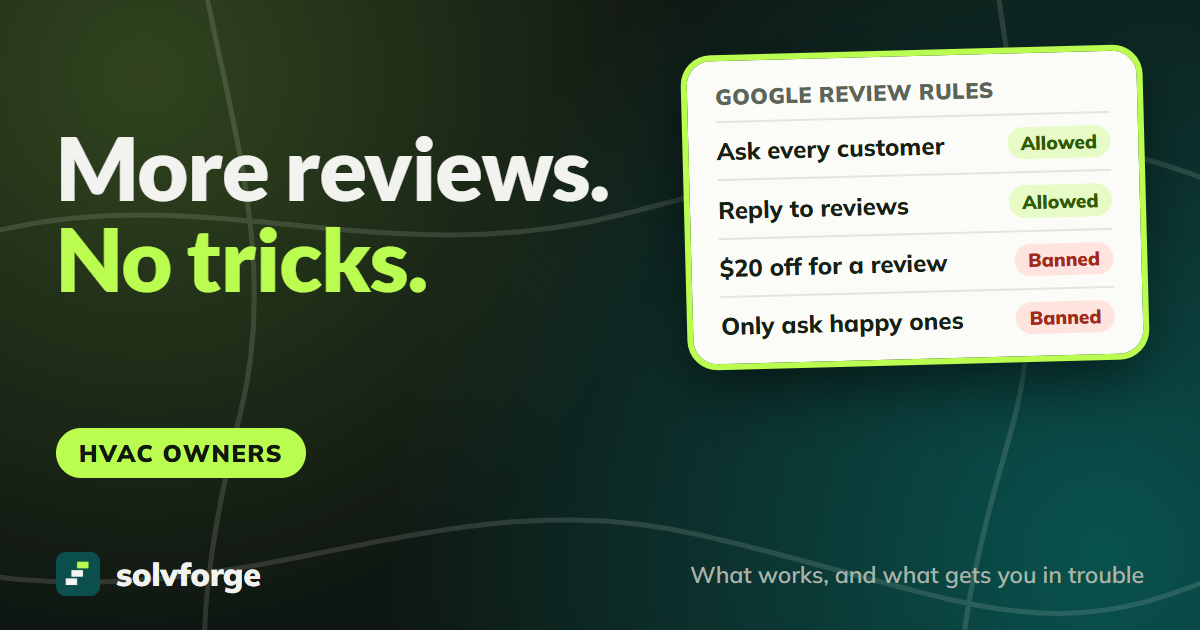
Google's policy is simple on the main point: businesses may ask for reviews that "represent a genuine experience, without offering incentives". Asking is fine. Asking everyone is fine. Making it easy is fine.
Google even gives you the tools. Your Business Profile can create a review link and a QR code that open the review form directly, so the customer doesn't have to search for you first.
Make asking part of every job
The best time to ask is right after the work is done, while the house is warm again and the customer is relieved. A request that arrives three weeks later with the invoice gets ignored.
A simple routine that works for most shops:
- The tech mentions it at the end of the job. Something plain: "If you were happy with the visit, a Google review really helps a small company like ours." No script about stars.
- A text goes out the same day with your review link. One sentence and the link. Texts get opened. Long emails don't.
- One reminder, a few days later, if they haven't reviewed. Then stop.
- Ask every customer the same way. Not just the ones who seemed happy. That last point matters more than it sounds, as you'll see below.
A small card with the QR code, left with the invoice or on the furnace, helps customers who'd rather do it later.
Reply to reviews, all of them
Replying shows future customers that someone is paying attention. Keep replies short and human. Thank people by name if they used theirs. Mention the job if it's natural ("glad we could get the heat back on before the weekend").
For negative reviews, reply once, calmly, without arguing in public. Say you want to make it right and give a way to reach you. A measured reply to a bad review often reassures the next customer more than five glowing ones.
Only report a review to Google if it breaks Google's rules, for example if it's fake, from a competitor, or not about a real experience. "Unfair" isn't enough.
The tactics that get you in trouble
These are all common. Some are pushed by marketing companies. All of them carry real risk.
Discounts, gift cards or prize draws for reviews
Google's policy says businesses may not offer "payment, discounts, free goods and/or services" in exchange for reviews. That includes "$20 off your next tune-up for a review" and entering reviewers into a prize draw.
In the US, the FTC's rule on consumer reviews, in effect since October 2024, also bans buying positive reviews, and the FTC can seek civil penalties.
Only asking the happy customers ("review gating")
This is the one that catches honest companies out. A common setup sends a message like "How did we do?" Customers who tap a happy face go to Google. Customers who tap a sad face go to a private feedback form.
Google's policy says businesses may not "selectively solicit positive reviews from customers." Filtering unhappy customers away from Google is exactly that. Ask everyone for a review in the same way. If you also want private feedback, ask for it separately, not as a gate.
Reviews from staff, family or friends
Google prohibits content based on a conflict of interest, and its policy names "current or former employment" as one. Your techs and your family shouldn't be reviewing you, however good the work is.
Pressure on the doorstep
Google also says businesses shouldn't "require or pressure users to leave ratings or write reviews while on the premises." For a home service company, that means a tech shouldn't stand there waiting while the customer writes it. Mention it, leave the link, and let them do it in their own time.
Buying reviews or review "packages"
Fake reviews break Google's rules and the FTC rule. Google removes them, and profiles caught with them can be restricted. There's no version of this that's worth it.
Telling unhappy customers not to post
Google says businesses may not "discourage or prohibit negative reviews." Fix the problem and let the customer decide what to write.
Give your techs a reason to care
Techs are the ones in the customer's house, so their buy-in decides whether this works. Share new reviews that mention them by name. Praise them in the team meeting.
Be careful with targets. Google's policy says businesses may not ask staff to solicit "a certain number of reviews" or reviews "that include specific content." Encourage the habit of asking, not a quota.
A checklist you can start this week
- Get your review link and QR code from your Business Profile.
- Add a same-day review text to your job-completion routine.
- Brief your techs: ask every customer, the same way, then leave it with them.
- Turn off any "happy or unhappy" filter that only sends happy customers to Google.
- Remove any review discount, gift card or prize draw from your website, emails and invoices.
- Reply to every new review this week, including the old negative one you've been avoiding.
Then look again in a month. You should see reviews arriving steadily rather than in bursts, which looks better to customers too.
If your website and Google profile aren't telling the same story, for example different phone numbers, hours or services, we'll check them for free.